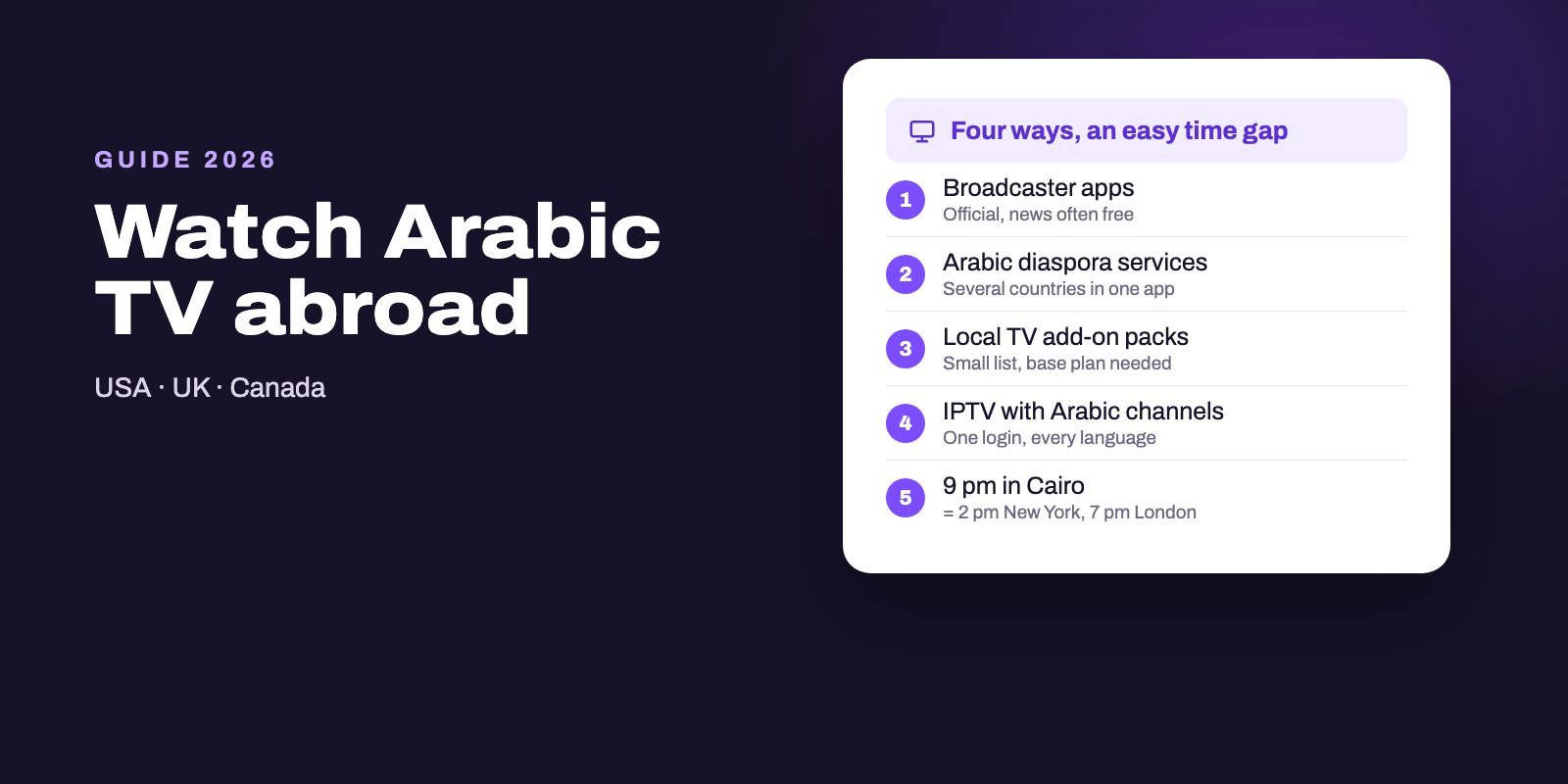
You can watch Arabic TV from the USA, the UK or Canada in four ways: the official apps and websites of Arab broadcasters, streaming services built for Arabic-speaking families abroad, Arabic add-on packages from local cable, satellite or streaming providers, and IPTV subscriptions that carry Arabic channels next to everything else. News channels from the region often stream live for free. Which route fits depends mostly on which country's television you grew up with.
That last point is the one that services rarely tell you. Arabic TV is not one market but several, Egyptian, Levantine, Gulf and North African, and a package that is rich in one can be almost empty in another. Pick by country first and by price second. The good news is the clock: Arab prime time reaches the US East Coast in the early afternoon and the UK in the evening, so live viewing is far easier than from most other regions.
Note: Smart IPTV App is an IPTV provider, and we promote our own service on this page. The apps and devices mentioned here are made by independent companies.
Last checked: October 13, 2026. Time differences are calculated for New York, Toronto, Los Angeles and London, in summer and winter. We do not name individual channels, satellites or services; what each option offers depends on your country and changes over time.
Four routes to Arabic television, compared
| Route | Strong point | Weak point | Pick it if |
|---|---|---|---|
| Broadcasters' own apps and websites | Official, often free for news and some shows | One broadcaster at a time; live channels are often limited outside the region | You follow one or two broadcasters |
| Arabic streaming services for the diaspora | Many channels from several countries in one app | Coverage leans toward certain countries | Arabic TV is all the household watches |
| Arabic add-ons from local providers | Same remote and same bill as your regular TV | Small selection, base plan required | You keep cable or satellite anyway |
| IPTV with Arabic channels | Arabic, local, sports and film channels under one login on several screens | Quality varies a lot between providers | The family watches in more than one language |
Free streams and the so-called Arabic TV boxes sold online get their own sections below, because they cause more confusion than anything else.
Start with the country, not the channel count
A service advertising hundreds of Arabic channels tells you very little. What matters is where those channels come from. Broadly, Arabic television splits into four families, each with its own dialect, its own stars and its own idea of a good evening on the sofa.
- Egypt. The largest film and drama industry in the Arab world, plus talk shows and comedy that viewers across the region follow.
- The Levant. Lebanon, Syria, Jordan and Palestine, known for drama series, music and entertainment shows, and lively political talk.
- The Gulf. Saudi Arabia, the Emirates, Kuwait, Qatar and their neighbors, with big-budget general channels, religious programming and plenty of sport.
- North Africa. Morocco, Algeria and Tunisia, whose channels speak local dialects that viewers from the East can struggle to follow, and often mix in French.
Iraqi, Yemeni, Sudanese and Libyan viewers each have their own national channels too, and they are the ones most often missing from packages. So before comparing prices, write down the five channels your family would miss most, and check each one by name against the service's list. A Moroccan grandmother and a Lebanese teenager can live under the same roof and want completely different line-ups.
Route 1: broadcasters' apps and websites
Many Arab broadcasters publish their own apps and stream at least part of their output on their websites and official video channels. News is the easiest to find: several of the region's news networks stream live around the clock, worldwide, for nothing. Entertainment is patchier. Some broadcasters put recent episodes of their series online after they air, others lock them inside a paid streaming platform, and the live entertainment channel itself may be blocked outside the Middle East and North Africa because of rights deals.
This route costs little and is perfectly legal, so it is the natural first step. It falls short when the family wants live channels from several countries on the big screen, with a proper program guide, without hopping between six apps on the remote.
Route 2: Arabic streaming services for families abroad
A handful of services exist purely to bring Arabic television to the diaspora in North America, Europe and Australia. They gather live channels from several countries into one app, add on-demand series and films, and sell monthly or yearly plans. Some come with their own set-top box, others run on smart TVs, sticks and phones.
Three questions separate the good ones from the disappointing ones. Does the line-up actually cover your country, and not only the big pan-Arab networks? Does the app exist for the device you own, so you are not forced to buy their box? And what happens during Ramadan, when every Arab household abroad tunes in at the same moment and weaker services start to buffer? Reviews written in March and April are a good stress test.
Route 3: Arabic add-ons from your local provider
In all three countries, some cable, satellite and live streaming companies sell an Arabic or Middle Eastern package on top of a regular plan. You keep one bill and one remote, which suits viewers who want local news and sport in English as much as programs from home.
Expect a short channel list, built around the large pan-Arab networks, and a base plan you must keep paying. The selection also differs from region to region, so ask for the exact list at your address before you sign anything.
A word on satellite dishes, since many families remember watching that way back home. The satellites that carry most Arabic channels are aimed at the Middle East, North Africa and Europe. From North America a dish simply cannot see them. In the UK reception is possible with a large, carefully aligned dish, but it is a project for enthusiasts rather than a quick fix, and a dish on the front of a rented flat is often not allowed in the first place.
Route 4: IPTV with Arabic channels
IPTV brings live channels over your internet connection into a player app on a TV, stick, phone or laptop. Services like ours carry Arabic channels inside a much wider line-up, so one subscription covers the parent who wants an Egyptian talk show, the child who wants cartoons in Arabic and the partner who would rather watch European football.
Its other strengths are practical. One login works in any player, on up to several screens at once, with a full program guide and, where the provider offers it on a channel, catch-up. The weakness is the market itself: providers range from excellent to useless, and the only reliable way to tell them apart is to watch. Use the trial during the hours you would really watch, and check your country's channels one by one. Our guide to IPTV player apps and Android TV app comparison show which players to install.
Free Arabic TV: what is real and what is not
Free and legal options do exist. Regional news networks stream live on their official websites and video channels, several broadcasters post full episodes of older series, and a few free, ad-supported streaming apps include some Arabic content. If you mostly want the news from home, you may not need to pay at all.
Search a little further and you meet the other kind of free: apps with names like "All Arabic Channels" that are not made by any broadcaster, and long lists of Arabic channel links shared on code-hosting sites and social media. They tend to vanish without warning, some are loaded with aggressive ads, and nobody stands behind them when they stop working on the evening of the series finale. Treat anything free that claims to carry every channel as a red flag rather than a bargain.
What is an "Arabic TV box", really?
Search for Arabic TV in the US or the UK and you will see plenty of boxes for sale, promising thousands of Arabic channels for one payment. Under the plastic, almost all of them are ordinary Android TV boxes with an app or a subscription preloaded. The hardware is often cheap and slow, the preloaded service is the part you are really paying for, and when it is not renewed or stops working, the "lifetime" box is left with nothing to show.
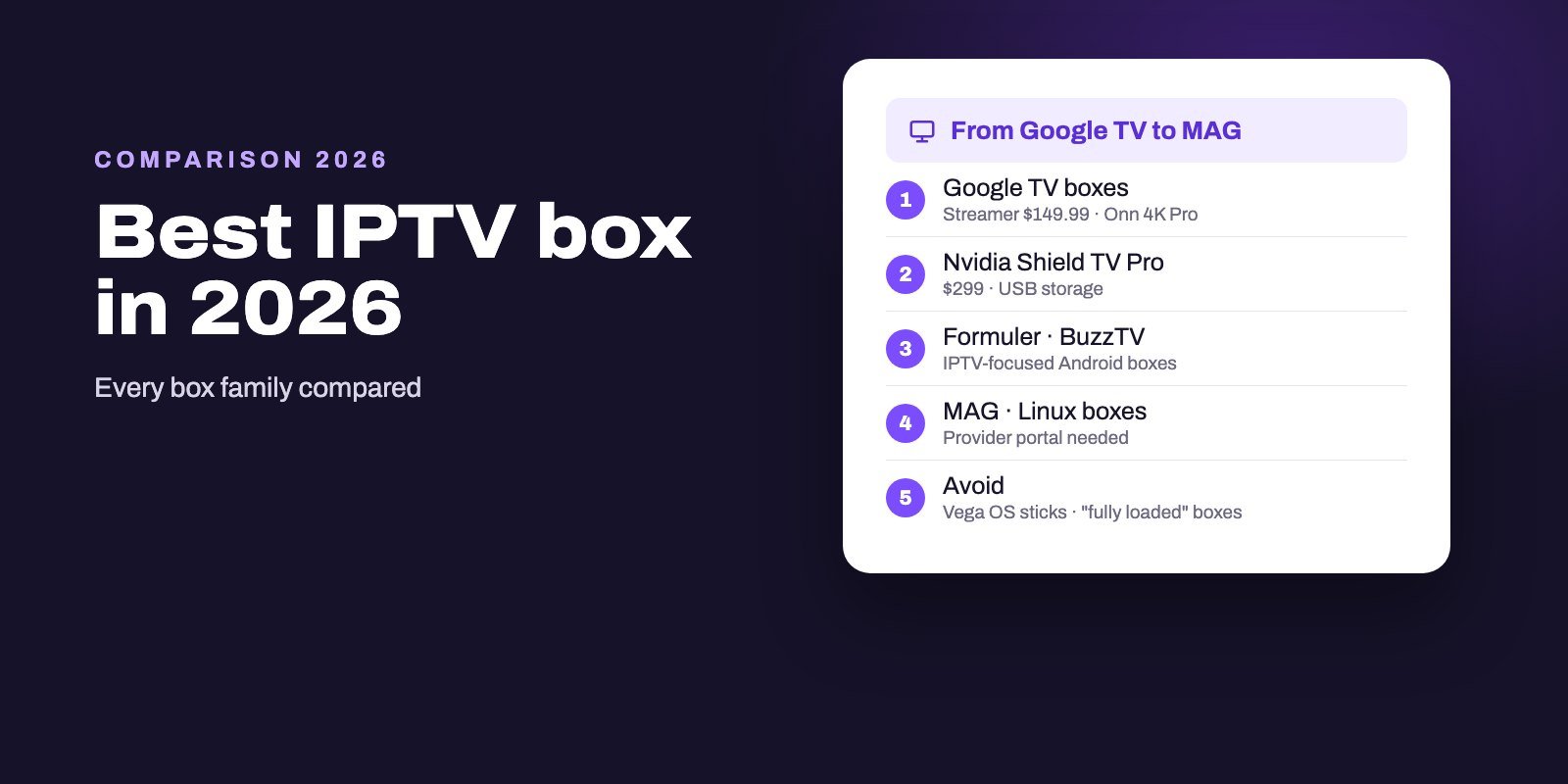
A better approach is to separate the two. Buy a decent, mainstream streaming device, then choose the Arabic service yourself, one you can test, renew and replace without throwing the hardware away. Our IPTV box comparison covers the devices worth buying, from Google TV sticks to the more powerful boxes for 4K.
The time difference works in your favor
Most of the Arab world sits seven to nine hours ahead of the US East Coast and two to four hours ahead of London. Gulf countries keep the same clock all year, while Egypt and Lebanon move theirs in summer, so some gaps change twice a year and others stay fixed:
| Region (example city) | Ahead of New York and Toronto | Ahead of Los Angeles | Ahead of London |
|---|---|---|---|
| Egypt, Lebanon (Cairo, Beirut) | 7 hours all year | 10 hours all year | 2 hours all year |
| Saudi Arabia, Jordan, Iraq (Riyadh, Amman, Baghdad) | 7 hours in summer, 8 in winter | 10 in summer, 11 in winter | 2 in summer, 3 in winter |
| Emirates (Dubai) | 8 hours in summer, 9 in winter | 11 in summer, 12 in winter | 3 in summer, 4 in winter |
| Morocco, Algeria, Tunisia | About 5 to 6 hours | About 8 to 9 hours | 0 to 1 hour |
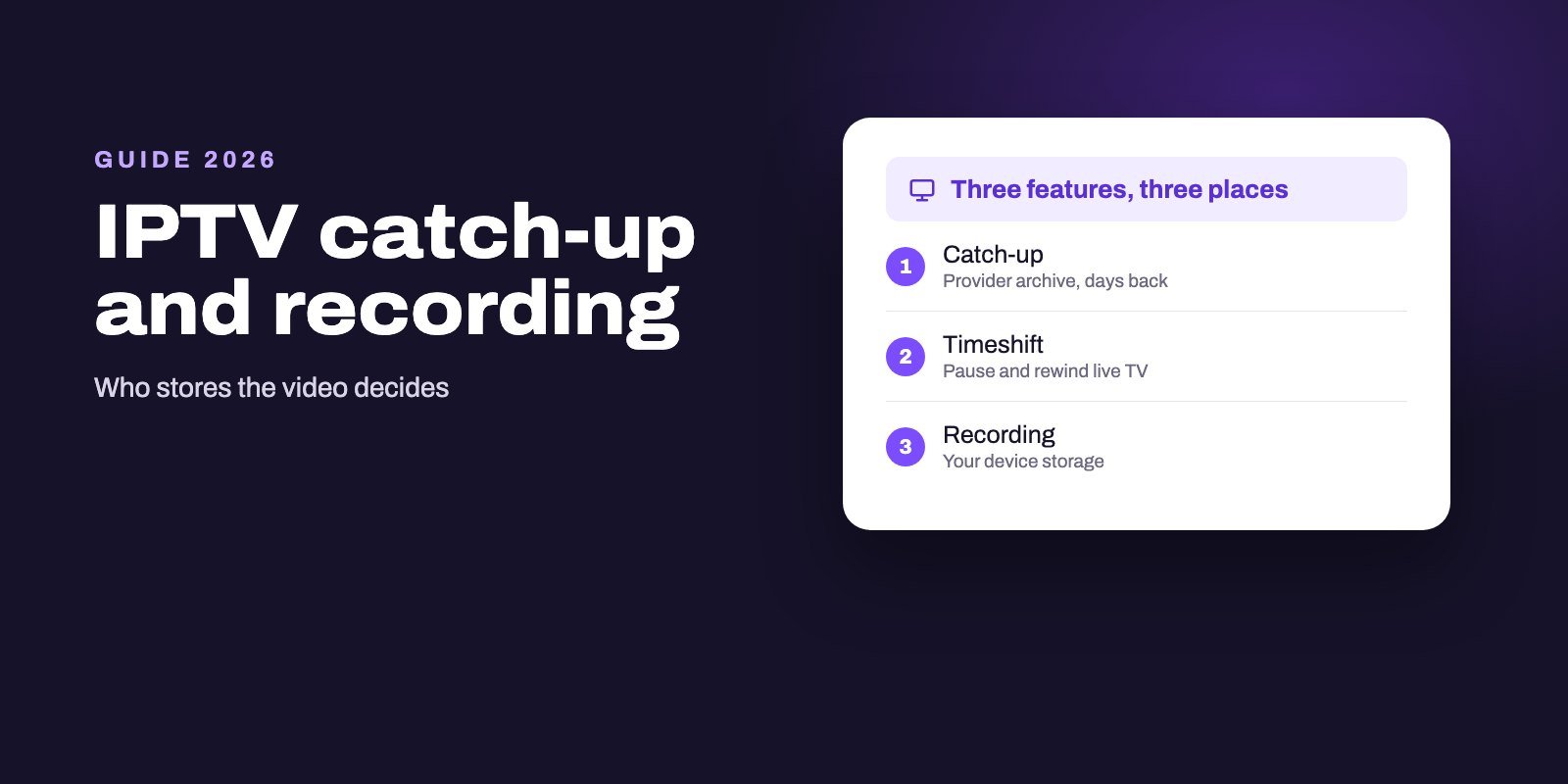
Put another way, a 9 pm show in Cairo starts at 2 pm in New York, 11 am in Los Angeles and 7 pm in London. British viewers can watch the evening schedule almost as it happens. On the US East Coast it lands after lunch, which is fine at weekends and awkward on workdays, and on the West Coast it falls in the late morning. That is where catch-up earns its keep: the evening's episode is waiting when you get home. Our catch-up and recording guide explains what to look for, and the EPG guide shows how to make the program guide display your local time instead of Cairo's or Riyadh's.
Ramadan: the month that tests every service
For Arabic television, Ramadan is the year's main event. Channels launch their biggest series of the year, episodes air every evening after iftar, and conversations in the family group chat revolve around the same shows. For 2027 the month is expected to begin in early February, the exact day depending on the moon sighting.
Abroad, this has two consequences. First, demand on every Arabic streaming service spikes at the same hour, so a service that is fine in October can struggle in February. Second, families who fast follow a schedule tied to their own sunset, not the broadcaster's, so the evening episode in Cairo often airs while you are still at work or just sitting down to eat. If Ramadan series matter in your house, test a service before the month starts, check that catch-up covers the channels running the series you follow, and make sure your plan allows enough screens for everyone who will be watching at once.
Firestick, Roku and smart TVs
Most Arabic services and IPTV players run best on Android TV and Google TV devices, which have the widest choice of apps. Amazon Fire TV sticks on Fire OS handle them well too, and our Firestick installation guide walks through the setup, though the newest Vega OS models are not suitable for IPTV players.
Roku has a few Arabic apps in its channel store but very limited support for IPTV players; our Roku guide lists the workarounds. On Samsung and LG TVs, check that your chosen service has an app for your model year before you pay. When in doubt, a Google TV stick plugged into a free HDMI port costs less than a month of frustration.
Keeping the language alive for the kids
Parents often bring up a reason that never appears in service comparisons: children. Kids born in Houston, Manchester or Mississauga tend to understand Arabic but answer in English, and cartoons, children's channels and family shows in Arabic are one of the easiest ways to keep the language in daily use. Classical Arabic is common in children's programming, which gives them a register they rarely hear at home, while a series in the family's own dialect connects them with grandparents and cousins.
If this matters to you, ask specifically for the Arabic children's channels a service carries, and set up a separate favorites list for the kids so they land on those channels first instead of scrolling past them.
USA, UK or Canada: what changes
The four routes exist in each country, but the details shift. In the UK, the short time gap makes live viewing easy, and broadcaster apps tend to work better from Europe than from North America. In the US, viewers rely more on catch-up and on services built for the diaspora. Canada has the time zones of the US, along with large Lebanese, Egyptian, Moroccan and Algerian communities, and many North African families in Quebec also want French-language channels in the same package, which is worth checking upfront.
In every country, the connection counts as much as the service. A wired connection to the TV box, or a strong Wi-Fi signal in the living room, removes most of the buffering people blame on the provider.
Questions to ask before you pay
- Which countries are covered? Check your five must-have channels by name, not the total channel count.
- Which devices? Make sure the service runs on the TV or stick you already own.
- How does it cope at peak time? Read reviews from Ramadan or big match nights, and test in your own evening.
- Is there catch-up on your channels? Essential in North America, useful everywhere.
- How many screens? Count everyone who watches at the same moment, not just the people in the house.
- Who answers when something breaks? A real contact by WhatsApp or email beats a ticket system nobody reads.
Try Arabic channels with Smart IPTV App
Arabic channels are included in the Smart IPTV App line-up, together with international, sports and film channels, and every plan comes with both Xtream and M3U details so it runs in the player of your choice. Our Arabic IPTV page details the plans. Tell us which country's television your family watches and we will point you to the matching channels, then check them during your own evening with our free 24-hour trial. Plans cover one to four screens, and your login arrives by WhatsApp or email within minutes of payment. Prices for the USA, the UK and Canada are on our country pages, and every plan is listed on the subscription page.
Frequently asked questions
How can I watch Arabic TV channels in the USA?
Use a broadcaster's own app or website, an Arabic streaming service for the diaspora, an Arabic add-on from a US TV provider, or an IPTV subscription that includes Arabic channels. Choose based on which Arab countries your family watches.
How can I watch Arabic TV for free?
Several regional news networks stream live for free on their official websites and video channels, and some broadcasters post full episodes online. Free apps claiming to carry every Arabic channel are unofficial and unreliable.
What is the best Arabic TV box in the USA?
Most boxes sold as Arabic TV boxes are ordinary Android TV boxes with a service preloaded. A mainstream Google TV or Android TV device plus a service you choose and can test is usually the safer buy.
How do I watch Arabic channels on a Firestick?
Install your service's app from the Amazon Appstore, or install an IPTV player such as TiviMate through the Downloader app on Fire OS models. The newest Vega OS sticks do not support these players.
What time do Arabic shows air in the US and the UK?
Egypt and Lebanon are 7 hours ahead of New York and 2 hours ahead of London all year; the Gulf is 7 to 9 hours ahead of New York. A 9 pm show in Cairo airs at 2 pm in New York and 7 pm in London.
Can I get Arabic channels with a satellite dish in the USA?
Not from the satellites that serve the Arab world, because they point at the Middle East, North Africa and Europe. In the US, Arabic channels come through local provider add-ons, apps or IPTV.
Can I watch Arabic channels on a Roku?
A few Arabic apps exist in the Roku channel store, but IPTV players are limited on Roku. Adding a Google TV or Fire OS stick is often the simplest fix.